
Xenomorphs and Forced Gestation: A Reproductive Case Study of the Alien Franchise

In 2022, multiple abortion bans were passed across the country, some of the most restrictive of which were passed in states like Florida, Georgia, Iowa, and South Carolina, prohibiting abortion after six weeks – earlier than most people even know they are pregnant. As a result, millions found themselves denied basic reproductive care. The pathways towards these bans were paved by the permitted overturning of Roe v Wade, the landmark Supreme Court case that legalized abortion in the US in 1973, with Dobbs v. Jackson Women’s Health Organization. On June 24, 2022, Justices ruled that access to abortion was not a constitutional right.

Millions of people immediately took to the streets in protest of the horror of people being denied their right to bodily autonomy. The decision by the state to force people into carrying fetuses resembles the horror of forced gestation in the Alien franchise, both examples of a loss of bodily autonomy as horror. The first installment of the Alien series, directed by Ridley Scott, is an iconic space opera chronicling the violence between the xenomorphs: shiny, phallic-shaped monsters with tentacles and a penchant for infecting hosts with their parasitic offspring, human crew, and synthetic robots. The primary audience of Alien is 80% men, who understand Alien as a commentary on the perils of space exploration. However, by centering women and forced gestation, I argue that a Reproductive Justice lens is critical to engagement with the film, calling attention to the relationship between the horror depicted on screen and that which is enacted in our country.
The first installment of Alien (1979) features a scene that defines the series. Awakened from hyper-sleep, the crew aboard the spaceship, Nostromo, answers a distress call from an abandoned ship. They send three crew members to investigate: Kane, Captain Dallas, and Navigator Lambert. Upon entering the craft, Kane finds a room full of xenomorph eggs, which Kane touches, causing the xenomorph to burst from the egg and attach itself to Kane’s face, sticking a long tentacle in his mouth down his
throat as its other tentacles wrap around his neck.
Kane is rushed back to Nostromo, and the crewmates remove the xenomorph. All seems well, and Kane is at dinner that night with his crew when suddenly, a xenomorph fetus erupts from his chest. The violent birth of the xenomorph in Kane’s chest cavity is iconic because of Scott’s impressive use of practical effects, and also because it shows a man being ripped apart to create a life he did not consent to. Released to audiences in the late 1970s, Alien is more than a manifestation of ongoing anxieties and fascination with space travel. Indeed, it is a powerful allegory for reproductive justice.
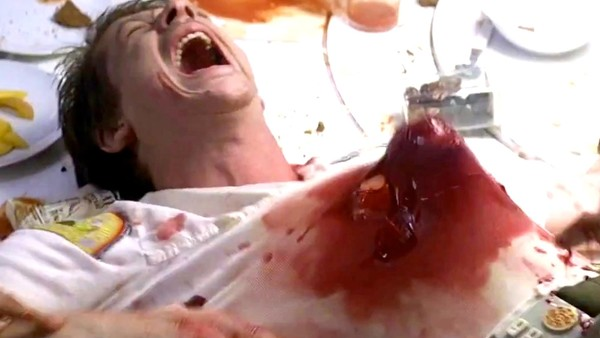
While reproductive rights campaigns in the early 1970s placed white women as the face of forced birth, the first installment of Aliens, produced just a few years later in 1979, uses a white man’s vessel. In the second installment of the franchise, Aliens (1986), the location of violence shifts to a white woman’s body, as the film, under a new director, James Cameron, centers Sigourney Weaver’s character, Ripley. The optimal host becomes the womb, which can harbor the xenomorph longer, and creates half xenomorph, half human monsters.
This motif of women and wombs plays out with more dramatic stakes in Aliens 3 (1992), where Weaver’s character Ripley chooses death over forced birth. When she learns she is impregnated with the xenomorph, she, in an act of bravery and defiance, decides she would rather die than give birth to this monster. Ripley creates an explosion and then falls back into the flames, terminating the xenomorph inside of her by way of ending her own life.
How many others have been forced to choose bodily harm to terminate a fetus? Despite abortion being legal, the 1990s still saw providers and clients being threatened with harassment, physical violence, and even death. The stakes of Ripley choosing to die rather than be an incubator are a quiet act of resistance in the face of being denied her bodily autonomy
Yet the iconography of the Alien franchise will always be the image of a man being split open, not of a woman choosing death over incubation. How do we translate the horror of a man being violated, impregnated, and discarded to the reproductive marginalization of non-men who are forced to carry fetuses to term daily? No consideration of their wants, their health, or even if they are alive, even dead women cannot escape forced birth.
Male viewers need to mobilize against the horror experienced by bodies in the real world. Ripley is a hero for choosing death to kill the xenomorph inside of her, but the women and non-men in your life are immoral for choosing their life and the termination of a fetus.
In this post-Roe world, where safe legal abortion is becoming harder to access and people are forced to cross state lines, to endanger their medical licenses, and even risk imprisonment, we need the fortitude of an allied fight in this movement. The very men who baulk at the sight of the chest cavity, bloody and oozing, need to find the horror in the daily reproductive violence happening around them.
Getting men to give a damn can begin with co-opting the iconographies of their favorite cinema and turning them into reproductive rights battlegrounds. Bring the fight for reproductive justice into the fandom communities mostly inhabited by men. Call Ripley a pro-choice hero and double down when dismissed. Use the liminal spaces of intergalactic travel as a metaphor for the cold, uncertain future of reproductive justice post-Roe.
We are not experiments, not incubators, not wombs, not anything central to our reproductive systems. We are autonomous and angry, and ready to be a bigger monster than the xenomorph to protect against forced birth, now, then, and forever.

Lily O (she/they) is a Black disabled woman whose gender is political and nonbinary. Lily is based in Boston, Massachusetts, and has been writing as …
More By This Author
Related Resources