COVID-19 & Disability Justice
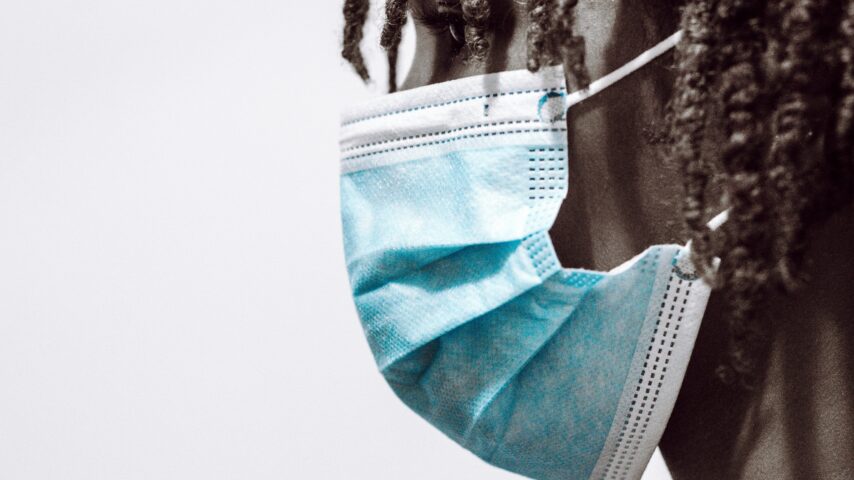
Masking has been such a contentious issue since the start of the COVID-19 pandemic that social media campaigns like “Black and Masked” have emerged to combat unsafe public health practices. However, there should be nothing contentious about it considering the facts on how the pandemic has changed yet always been present. Cases ebb and flow as more people struggle with the effects of Long COVID, and with many of those cases, COVID-19 has been compared to AIDS in its severity (and also similar with government inaction during both pandemics). The precautions people used to take to stay safe like masking, social distancing, testing prior to and during large gatherings and avoiding enclosed, indoor spaces are dwindling and in many cases, have fallen completely out of practice. And the absence of individual urgency has been codified by the government’s public health response (or lack thereof), with state governments attempting in places like Nassau County, New York and even New Jersey attempting to ban masking. Moreover, federal funding for state and community health departments as well as nongovernment organizations nationwide has significantly decreased, with public health officials outright saying that “the pandemic is over.” The truth is, COVID-19 is still here, it will most likely be here forever, and we must recognize that we can only resist its effects by working together to keep our communities safe.
Will I say that I’ve always been perfect with social distancing, wearing a COVID mask in crowded spaces, or consistently using at-home tests after traveling? No, but my compliance has increased as my knowledge about the realities of the pandemic has expanded. Since 2020, I’ve largely worn masks in really crowded spaces such as airports and tested myself when I’ve experienced symptoms. However, I didn’t realize how severe COVID-19 still was until Spring 2024 when I began coming across Instagram posts about the need for people to engage in COVID-conscious actions. Masking, testing, social distancing, and other public health precautions have been proven to keep us safe.
For years, COVID-19 and other respiratory viruses have been on the rise, so we need to do all we can to care for ourselves and others, especially the disabled and immunocompromised community. Encountering that one, singular post sent me down a rabbit hole, and I continued exploring why we still need to be masking and staying safe. What stood out to me in particular was how many radical, leftist, COVID-conscious people there were, especially those in the disabled community. They charged that other radicals and leftists were failing to be truly revolutionary in their praxis by not taking actions to protect themselves and others from the pandemic.
So, why don’t people mask? I’m sure you could guess, but it’s multiple reasons: it’s seen as inconvenient and annoying, masks can pose sensory issues, there is a financial cost associated with purchasing personal protective equipment (PPE), and masks can exacerbate or induce what people have termed “mask-acne.” YouTuber and social commentator Tee Noir offers a more complicated and layered analysis of the resistance to wearing masks. She argues that, in a society where physical and visual presentation are emphasized and people who “look” better get benefits ranging from the door being held open for them to bonuses at work, masks “push [us] into anonymity.” Indeed, a 2023 research study conducted by Seoul National University indicates that people who perceived themselves as more attractive were less likely to wear a mask, and people who perceived themselves as less attractive were more likely to wear a mask. Either way, for all these reasons and more, COVID-consciousness is near non-existent as a society, and disabled and immunocompromised folks are suffering the most from it.
This is where disability justice as a theory, framework, and praxis comes in. Disability justice moves away from a focus on disabled people acquiring legal rights, or merely fighting for access in an ableist world, instead envisioning a world where disabled people are centered, loved, and wholly liberated. Disability justice is also about relationship-building and creating safe communities for each other, fighting against the idea that independence is the answer when in reality, it will only isolate and ultimately kill us.
In order to understand disability justice, the history behind the movement, and its continued relevance, we must deepen our understanding of eugenics. Eugenics is the action behind scientific racism – scientific racism is the ideology that non-white people, disabled people, and LGBTQ+ people are inherently inferior, while eugenics is the theory that the aforementioned “undesirable traits” can be eliminated via “selective breeding.” Part of scientific racism is the idea that certain traits like blue eyes, blond hair, and white skin are more desirable than others. The eugenics movement believes that “undesirable” populations should not reproduce or, ultimately, live. Historical instances where eugenics has been implemented includes the myth that Black bodies were inherently laboring bodies – one of many justification for the Transatlantic Slave Trade, and the forced sterilizations of women of color in the United States. The COVID-19 pandemic serves as an even more recent example with the government’s scaling back of COVID precautions, leaving immunocompromised and less-resourced populations to fend for themselves. After learning all that I did about COVID-19 and the necessity of disability justice in early 2024 and onward into the summer, I was changed forever and couldn’t look back. Later that year, I would be given the opportunity to put actions behind what I had learned.
From November 2024 to June 2025, I was an Engage, Learn, Lead, and Act (ELLA) Fellow with the Sadie Nash Leadership Project. Throughout those eight months, I created and implemented a community project titled, “We Keep Us Safe: COVID-19 & Masking,” which focused on the importance of masking to prevent COVID-19 and other respiratory viruses, especially to protect disabled and immunocompromised folks. I was heavily inspired by “mask blocs,” which are groups nationwide that host COVID-conscious events, distribute COVID-related resources, and educate their communities. Approximately every two weeks, I would refill bins I set up at my local library with KN95 masks, tests, and zines for people to take, free of cost. I secured bulk donations of 500 kids-sized KN95 WellBefore Masks and 400 adult-sized KN95 Bona Fide Masks, and all I had to pay for were the shipping costs. I also received a donation of 200 COVID tests from Mask Bloc NJ.
Initially, I was concerned about how people would react to my project and thought no one would engage with it. However, the exact opposite happened – over the course of about four months, all the PPE and COVID-education zines were taken. The librarians who interacted with community members first-hand shared the impact of my project on the community, noting that people were enjoying the project and had been taking a lot of the resources. Something so small, me walking into the library, restocking the bins, and walking out all in less than 10 minutes proved to be so meaningful. It showed that people do care about keeping themselves and their communities safe, they just need the resources to be able to do so. This is something that you can do in your community! Whether it’s a solo, partnered or group effort through an initiative like a mask bloc, these efforts can make a massive difference. There are dozens of mask blocs nationwide, and there are also multiple videos and resources online explaining how we can get more involved in community efforts such as mutual aid. Make sure to continuously stay up-to-date about COVID-19 cases nationwide and in your area via trusted sources, and follow content creators who continue to talk about COVID-19 and disability justice as well. Whether it’s creating a community project or making sure you wear a mask next time you’re on the bus, these are all important actions that keep us, our loved ones, and our communities safe because, ultimately, we keep us safe.

Nadia L (she/her) is a reproductive justice and health equity advocate born, raised, and currently based in Northern New Jersey. She is a Spring 2024 graduate …
More By This Author
Related Resources